
There is a “Cave analogy” of Plato (428-348 BC); Plato contemplates a group of people living in an underground cave. In the analogy that these people sit with their backs facing the entrance of the cave, they can only see the stone wall of the cave. Their hands and feet are also tied. They see some images on this wall they look at in the cave, the shadows created by the light are reflected on the wall. These images are their only reality. It’s like a shadow play. Since they have always sat like this since they knew themselves, they think that shadows are the only reality that exists. However, if one of them got rid of their chains and started to investigate where these shadows came from, would the cave still be a cave?
Nature is not dark, but if the thought is in the dark everything is in the dark. Man can create his own cave, or his story may have started in a cave.
While men were thinking about these things before Christ, it was only in the second half of the 19th century that efforts to understand the inner world of people turned into a discipline. They wanted to use tools and equipment used in natural sciences such as biology and physics to study human beings. Thus, a path from the darkness of the human being to the light of the person began to be followed on the concepts of behavior, mind, perception, memory and learning. The foundation of the science of psychology was 1879 with Wilhelm Wundt … My great grandfather was born on this date, a hundred years later in 1979, I am seven years old (the transitions are dizzying) and 100 years later, in 2079, I believe my youngest grandson will definitely come out of the cave first (although I can’t see)
The mother of all sciences were not the science of philosophy, there would not be the science of psychology, and also, without human experience, there would not be philosophy in antic age…
Human potential in workplace was about this story. The talent and performance management approach was about “how do the workers feel if the temporal balance of light and or dark differs” and it was discovered that more light made a big difference in the performance of workers in those days in late19th.
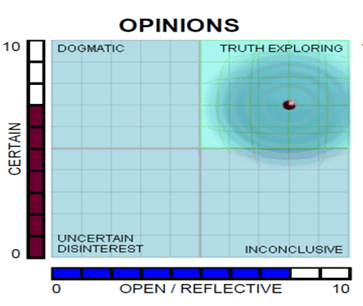
How do you read the graph? Does this person have a greater tendency to act firmly / sure of her/his own opinions and/or has a greater tendency to explore others’ opinions? with light or without the light or without balance having some shadows on the wall?
With love,
Ca
 SİNERJİK